
Quick Answer: GEO, or Generative Engine Optimization, is the practice of structuring your content so that AI platforms like ChatGPT, Google AI Overviews, and Perplexity cite your business when generating answers to user queries. Unlike traditional SEO, which focuses on ranking in Google’s list of blue links, GEO focuses on getting your brand included in AI-generated responses. With 37% of consumers now starting searches in AI tools according to Search Engine Land’s January 2026 report, GEO has moved from an emerging concept to a practical marketing priority for businesses of all sizes.
A small business owner in Chicago asked ChatGPT for recommendations on local SEO agencies. The AI gave a detailed, confident response, named three firms, explained what each one does, and even summarised why each might be a good fit.
Not one of those three firms had optimised specifically for that response. They just happened to have well-structured, credible content that AI systems could understand and cite.
That is the new reality. AI is now part of how customers find businesses, and if your content is not structured in a way that AI can extract and reference, you are invisible in that channel entirely.
What Is GEO and Why Is Everyone Talking About It
GEO stands for Generative Engine Optimization. It was formally introduced as a concept in a research paper published by Princeton University, Georgia Tech, and IIT Delhi in 2023, and by early 2026, it has become a standard part of digital marketing strategy for brands that want to stay visible as search behaviour shifts.
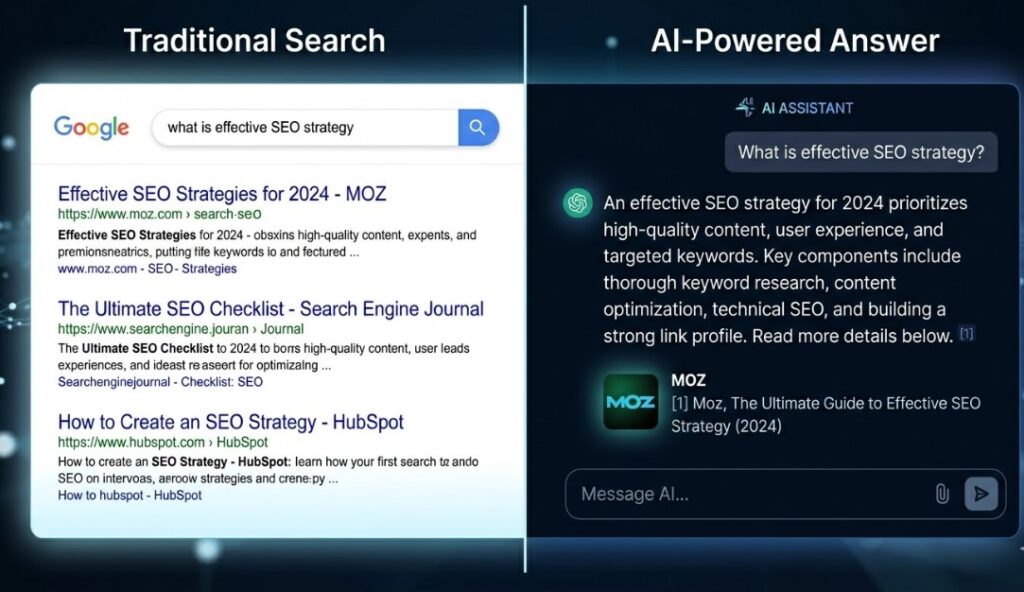
The core idea is straightforward. Traditional SEO gets you ranked in Google’s search results. GEO gets you cited in AI-generated answers.
When someone asks ChatGPT “what is the best accounting software for a small business” or asks Perplexity “which digital marketing agencies are good for local SEO,” these platforms pull from multiple sources across the web and synthesise an answer. GEO is the discipline of making sure your content is one of the sources they pull from.
How GEO Is Different from SEO
This is where a lot of confusion creeps in, so it helps to be specific.
SEO optimises for a ranked list of links. You want your page to appear at position one, two, or three for a given search term. The user sees the list and decides which link to click.
GEO optimizes for inclusion in an AI-generated answer. There is no ranked list. The AI reads multiple sources, synthesizes the most relevant and credible information, and presents a single response. Your brand either appears as a cited source in that response, or it does not.
| Factor | Traditional SEO | Generative Engine Optimization (GEO) |
|---|---|---|
| Goal | Rank in Google search results | Get cited in AI-generated answers |
| Platform | Google, Bing | ChatGPT, Perplexity, Google AI Overviews, Gemini |
| Success metric | Search ranking position | Citation frequency and brand mention share |
| Content format | Keyword-optimised pages | Structured, fact-dense, answer-first content |
| Backlink impact | High | Medium, credibility signals matter more |
| Speed of results | Months | Varies, some platforms update citation sources frequently |
| Can you do both | Yes | Yes, GEO builds on SEO, it does not replace it |
The critical thing to understand is that GEO does not replace SEO. It adds a layer on top of it. Brands with strong SEO foundations tend to perform better in GEO because AI systems use many of the same credibility signals, domain authority, backlinks, content quality, and E-E-A-T, to decide which sources to trust.
Why This Matters for Your Business Right Now
The numbers make a compelling case for taking GEO seriously.
Google’s AI Overviews now appear in an estimated 30 to 40% of all search queries, according to data cited by Enrich Labs in early 2026. ChatGPT reaches over 800 million weekly users. And according to Gartner’s forecasting research, traditional search engine volume is projected to decline by 25% as users shift to AI-powered answer engines.
That does not mean Google is dying. It still owns the overwhelming majority of search. But a meaningful and growing portion of how people discover brands, compare options, and make decisions is now happening inside AI tools.
If your business is not showing up in those answers, you are missing a portion of your target audience that is only going to grow.
Early movers have a real advantage here. The brands that establish credibility with AI systems now will be the ones those systems cite repeatedly as the technology matures. Citation authority in AI search compounds over time, similar to how domain authority has always worked in traditional SEO.
What GEO Actually Looks Like in Practice
GEO is not a separate technical system you install. It is a set of content and structural practices that make your existing pages more useful to AI systems.
Write in an Answer-First Format
AI systems extract answers. They do not want to read five paragraphs before getting to the point. Every major section of your content should open with a direct answer to the question that section addresses, then expand with context and supporting detail.
This is also how you already write for featured snippets in traditional SEO. GEO just extends that discipline across AI platforms.
Include Specific, Verifiable Statistics with Named Sources
According to Princeton’s GEO research, adding citations, statistics, and quotations to your content can improve AI visibility by 30 to 40% compared to unoptimised content. AI systems favour content that is factual, specific, and traceable.
Vague claims get ignored. Specific, sourced data gets cited.
Structure Content with Clear Headings and Short Paragraphs
AI platforms break content into chunks when synthesising answers. If your content is one long wall of text, it is harder for an AI to extract a specific, useful passage from it. Short paragraphs, clear H2 and H3 headings, and logically separated sections all make your content more extractable.
This also improves your E-E-A-T signals, which matters for both SEO and GEO. If you want to understand how E-E-A-T works and why it matters, our guide to E-E-A-T for local businesses breaks it down in detail.
Build Credibility Beyond Your Own Website
AI systems do not just read your site. They read the entire web. Third-party mentions, guest posts on credible sites, podcast appearances, digital PR mentions, and citations from authoritative sources all signal that your brand is trustworthy and worth referencing.
This is why guest posting is genuinely valuable in an AI-search world, not just for backlinks but for building the kind of external credibility that AI platforms recognise.
Use Schema Markup
Structured data helps AI crawlers understand what your page is about and extract specific information accurately. FAQ schema, Article schema, and Organisation schema are all practical starting points for any small business. We covered this in the context of our SEO services and it applies equally to GEO.
What GEO Does Not Mean
A couple of things worth being clear about.
GEO does not mean abandoning Google. Google still dominates search and is not going away. What changes is that your content strategy needs to serve both traditional search and AI platforms simultaneously, and the good news is that the overlap is significant.
It also does not mean writing for robots. The content practices that work best for GEO, clear writing, specific facts, logical structure, genuine expertise, are the same things that make content genuinely useful for human readers. There is no tension here.
Where to Start With GEO
Start by auditing your existing content. Look at your key service pages and blog posts. Are they answer-first? Do they include specific, sourced statistics? Are they clearly structured with descriptive headings?
If not, those are your quick wins. Update your most important pages to lead with direct answers, add verifiable data points with source names, and break long paragraphs into shorter, more extractable chunks.
Then build new content with GEO in mind from the start. That means using the content structure outlined in this post for every article you publish going forward.
You do not need to be a large brand with a big team to do this well. The Princeton research is clear: it is content quality, structure, and credibility signals that drive AI citation, not company size.
If you have built a solid SEO foundation, GEO is a natural and achievable next step. If you have not started on SEO yet, our complete guide to what SEO is and how it works is the right place to begin, because GEO builds on that foundation rather than replacing it.
The search landscape is shifting. Businesses that understand both dimensions of that shift, traditional rankings and AI citations, are the ones that will maintain visibility regardless of how search behaviour continues to evolve.
Start optimising your content for AI now. The window for early-mover advantage is still open, but it will not stay that way for long.
Frequently Asked Questions
What is GEO in digital marketing?
GEO stands for Generative Engine Optimization. It is the practice of structuring your content so that AI platforms like ChatGPT, Perplexity, and Google AI Overviews cite your business in their generated answers. It differs from traditional SEO, which focuses on ranking in search engine results pages.
Is GEO replacing SEO?
No. GEO builds on top of SEO rather than replacing it. Strong traditional SEO foundations, good content, quality backlinks, and technical optimisation, all contribute to better GEO performance. Businesses that do both will have the most visibility across traditional search and AI-generated answers.
How do I get my business cited in ChatGPT or Perplexity?
The most effective ways are to write in an answer-first format, include specific and verifiable statistics with named sources, structure your content with clear headings and short paragraphs, build credibility through third-party mentions and guest posts, and use schema markup. According to Princeton’s GEO research, these tactics can improve AI visibility by 30 to 40%.
How is GEO different from AEO (Answer Engine Optimization)?
AEO was originally developed for voice search and featured snippets. GEO extends that concept to AI-generated responses across platforms like ChatGPT, Gemini, and Perplexity. The two disciplines overlap significantly and are increasingly treated as the same thing in current industry practice.
Why does GEO matter for small businesses specifically?
Small businesses often lack the budget to compete in paid advertising at scale. GEO offers a way to gain visibility in AI-generated answers, which are increasingly where buying decisions start, through content quality and structure rather than ad spend. According to Search Engine Land, 37% of consumers now start searches using AI tools, making GEO a high-value organic channel for businesses of any size.