
In Short: Off-page SEO covers everything you do outside your own website to build authority, trust, and credibility with search engines. Backlinks remain the most powerful off-page signal, but in 2026, brand mentions, digital PR, and unlinked citations are playing an increasingly important role alongside them. Small businesses that consistently build quality off-page signals rank higher, hold their positions longer, and are harder to displace by competitors.
A small accounting firm had spent six months perfecting their website. The content was clean, the headings were optimised, and the on-page SEO was solid. But they were stuck on page three for their most important keyword, and nothing they did to the site itself seemed to help.
The problem was not on their site at all. It was everywhere else.
Three of their direct competitors had dozens of backlinks from local business directories, regional news sites, and industry blogs. The accounting firm had four links, all from their own social profiles.
Off-page SEO was the gap. And once they started filling it, their rankings moved within 90 days.
If you have done the work on your on-page SEO checklist and your content is solid, but your rankings are still not where you want them, off-page SEO is almost certainly the missing piece.
What Is Off-Page SEO and Why Does It Still Matter
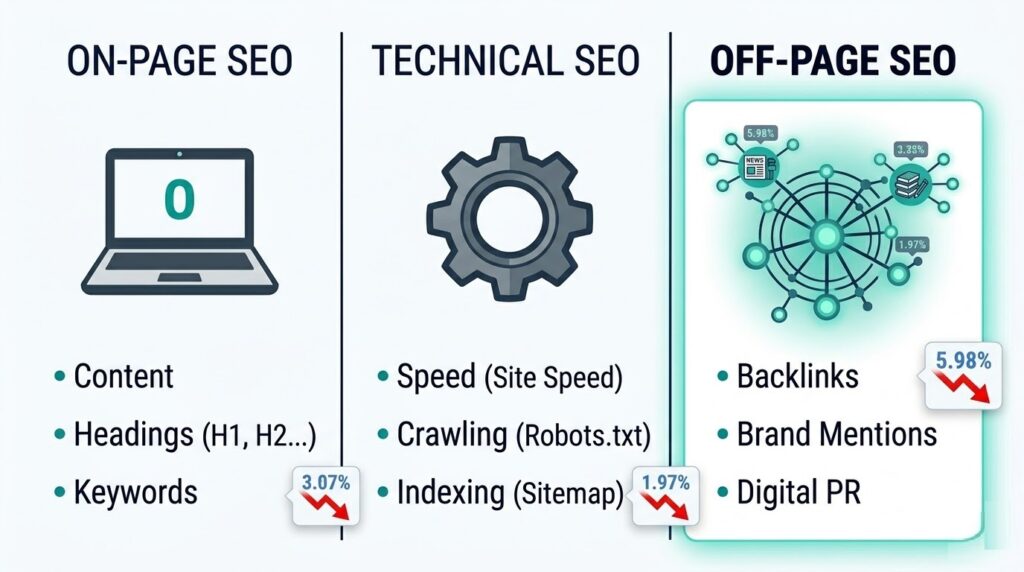
Off-page SEO refers to every action you take outside your own website to improve how search engines perceive your authority and trustworthiness. The most important of these signals is backlinks, but the picture is broader than that.
According to SearchAtlas’s 2026 analysis, backlinks now account for approximately 45% of off-page ranking weight, down from 80% in 2012. Brand mentions, entity signals, and sentiment now make up the remaining 55%. Google has become sophisticated enough to evaluate your reputation across the entire web, not just count the links pointing to your pages.
That is a significant shift. It means that even unlinked mentions of your business name on credible sites carry ranking weight. It also means that a consistent off-page presence, built over time across multiple channels, is more durable than a handful of backlinks from a single burst of link building.
If you are new to SEO and want to understand the full picture of how it all fits together, our complete guide to what SEO is and how it works covers the foundation before you build on it.
The Off-Page SEO Signals That Matter Most in 2026
Not all off-page activity is equal. Here is where to focus your effort.
Backlinks: Quality Over Everything
Backlinks are still the single most important off-page ranking signal. When another website links to yours, Google treats it as a vote of confidence. But the value of that vote depends entirely on who is casting it.
A single link from a respected industry publication or a regional news site is worth more than 50 links from low-quality directories or unrelated blogs. The businesses that rank consistently are not the ones with the most links. They are the ones with the most relevant, authoritative links.
According to Backlinko’s off-page SEO research, one of the most reliable ways to earn high-quality backlinks is to include original statistics or data in your content. Other sites cite that data, which generates natural, editorial links over time. A single well-researched article with a unique data point can earn backlinks for years without any active outreach.
There are two broad types of links to understand:
Dofollow links pass SEO authority from the linking site to yours. These are what directly boost your rankings and domain authority. Most editorial links from blogs, news sites, and industry publications are dofollow by default.
Nofollow links do not pass direct ranking authority, but they still drive referral traffic and contribute to a natural-looking link profile. Links from social platforms, forum comments, and some directories are typically nofollow.
A healthy backlink profile includes both. An overwhelming majority of dofollow links from a short period of time can look manipulative to Google. Natural link acquisition over time, mixed in with nofollow citations, is what a credible site looks like.
Guest Posting: The Most Controllable Link Building Strategy
Guest posting means writing content for another website in your niche, typically in exchange for an author bio with a link back to your site. Done well, it is one of the most reliable white-hat link building methods available to small businesses.
The key word is relevant. A guest post on a marketing blog for an SEO agency is a strong signal. A guest post on a food blog is not. Relevance matters as much as domain authority when Google evaluates the quality of a link.
When pitching guest posts, lead with value. Offer a specific topic idea that fits the host site’s audience, not a thinly veiled promotional piece about your own business. Sites that publish guest posts get pitched constantly. A specific, genuinely useful idea gets a reply. A generic pitch does not.
If you are planning to add guest posting as a service for your clients, this applies equally to them. Building topical relevance through strategic guest posts on industry-relevant sites is one of the fastest ways to move domain authority for a new website.
Digital PR: Earning Coverage That Compounds
Digital PR is the practice of earning media mentions and coverage on authoritative publications. Unlike traditional PR, the goal is specifically to generate links and citations that strengthen your SEO authority alongside the brand awareness.
The most effective angle for small businesses is expert commentary. Journalists and content managers regularly need quotes, opinions, and insights from industry experts. Services like HARO (Help a Reporter Out) connect journalists with sources and have helped countless small businesses earn links from high-authority publications at no cost.
Publishing original research or data is the other reliable PR-driven approach. According to Bluehost’s 2026 off-page SEO guide, data-backed articles and case studies consistently attract organic citations from other blogs and news outlets. One well-researched piece can generate backlinks for twelve months or more without additional outreach.
Brand Mentions: The Off-Page Signal Most Businesses Ignore
Unlinked brand mentions, places where your business name appears online without a hyperlink, are increasingly recognised as a genuine authority signal.
According to SearchAtlas’s 2026 research, 60% of new Google Knowledge Panels are now triggered by unlinked brand mentions from trusted sources, compared to 35% triggered by backlinks. Google’s natural language processing has become capable enough to associate your brand name with your website, your location, and your services, even without an explicit link.
This means reviews on Google Business Profile, mentions in forum discussions, references in comparison articles, and coverage in local directories all contribute to how Google perceives your authority. Monitoring and encouraging brand mentions is a low-effort, high-value off-page activity that many small businesses overlook entirely.
Local Citations for Small Businesses
If you serve a specific geographic area, local citations are non-negotiable. A citation is any instance where your business name, address, and phone number appear consistently across online directories and platforms.
The most important of these is your Google Business Profile, followed by Yelp, Apple Maps, Bing Places, and relevant industry directories. Consistency matters here. If your address appears differently across platforms, for example “Street” in one place and “St.” in another, it weakens the local authority signal.
Building local citations is one of the fastest off-page wins available to any small business, particularly for improving visibility in the Google Maps pack. It requires no outreach, no negotiation, and no cost beyond the time it takes to claim and complete each listing.
What Not to Do: Off-Page Tactics That Hurt More Than Help
Some link building practices that were common several years ago now carry real penalty risk.
Buying links from link farms or private blog networks is the most dangerous. Google’s algorithms have become increasingly effective at detecting artificial link patterns, and manual penalties for link scheme violations can take months to recover from.
Irrelevant directory submissions, mass article spinning, and comment spam are similarly ineffective in 2026. Even if they do not trigger a penalty, they dilute your link profile without adding authority.
The simplest test for any off-page tactic is this: would this link or mention appear naturally if your content were genuinely useful? If the honest answer is no, the tactic is probably not worth the risk.
Where to Start With Off-Page SEO Today
Start with what you can control immediately. Claim your Google Business Profile and complete every field. Submit to the five or six most important directories for your industry or location. Then look at your existing content and identify one article that contains a specific statistic or useful insight. Promote that article to relevant bloggers and journalists as a resource worth linking to.
Guest posting should follow once your on-site content is solid. Identify three to five relevant sites in your niche that publish guest contributions. Pitch a specific, useful topic and write the piece as well as you would for your own site.
Off-page SEO compounds over time. The sites that rank consistently are the ones that have been building authority steadily for months and years. The best time to start was six months ago. The second-best time is today.
The link building and outreach services at DigitixLab cover the full off-page strategy outlined in this guide, from citation building to guest post outreach, for businesses that want the work handled rather than learned from scratch.
Frequently Asked Questions
What is off-page SEO and how is it different from on-page SEO?
Off-page SEO refers to everything you do outside your own website to improve your search rankings, including building backlinks, earning brand mentions, and running digital PR campaigns. On-page SEO covers what you optimise directly on your pages, such as content, headings, and keywords. Both work together, but off-page signals tell search engines how much the rest of the web trusts your site.
How many backlinks does a small business website need?
There is no fixed number. What matters is the quality and relevance of the links, not the quantity. A small business with 30 high-quality backlinks from relevant industry sites will consistently outrank a competitor with 300 links from unrelated low-authority directories. Focus on earning fewer, better links over time rather than chasing volume.
Does social media help with off-page SEO?
Social media does not directly pass ranking authority to your website, as most social links are nofollow. But social media contributes indirectly by amplifying your content, increasing brand mentions, and driving the kind of visibility that leads to natural editorial backlinks from people who discover your work. Treat it as a distribution channel rather than a direct SEO tool.
What is the safest way for a small business to build backlinks?
The safest and most sustainable methods are guest posting on relevant industry sites, earning links through original data or research, digital PR through expert commentary, and building local citations. These approaches earn links naturally through value, which is exactly what Google rewards and what algorithm updates cannot penalise.
How long does off-page SEO take to show results?
Off-page SEO typically takes longer than on-page fixes because it depends on external factors like how quickly Google crawls newly acquired links and how much authority the linking site carries. Most businesses see measurable movement in rankings within three to six months of consistent off-page activity, with stronger results compounding over twelve months and beyond.