
Keyword research does not have to cost money. Most small business owners who have tried to understand SEO come across tools like Ahrefs, Semrush, or Moz and see price tags that start at $100 to $140 per month. They either subscribe without fully using the tool, or they skip keyword research entirely and publish content without knowing whether anyone is searching for it.
Both outcomes are a waste. Keyword research is the foundation of every effective SEO strategy, and you can do most of it for free if you know which tools to use and how to combine them.
This guide walks through a practical, repeatable keyword research process for small businesses using entirely free tools. It is the same process we use at DigitixLab when auditing a new client site before recommending a content strategy.
What Is Keyword Research and Why It Matters Before You Write Anything
Keyword research is the process of finding the exact words and phrases people type into search engines when looking for what your business offers, and then evaluating how difficult it would be to rank for those terms.
Without keyword research, you are guessing. You might write a detailed, well-structured blog post that gets no traffic because nobody is searching for the phrase you used in the title. Or you might target a keyword that is so competitive it would take years to rank for with a new domain.
Good keyword research removes both problems. It tells you what people actually want, at what volume, and with what level of competition, before you spend time creating content.
Understanding keyword intent is also critical here. Every search query falls into one of three categories. Informational intent means the person wants to learn something, like “what is keyword research.” Commercial intent means they are comparing options, like “best free keyword tools.” Transactional intent means they are ready to act, like “hire SEO agency for small business.” Each type needs different content, and mismatching content type to intent is one of the most common reasons well-written articles fail to rank.
As we covered in our guide to Google AI Overviews and SEO, understanding intent has become even more important as AI-generated answers displace pure informational content. Targeting commercial and transactional intent keywords is increasingly more protective of your organic traffic.
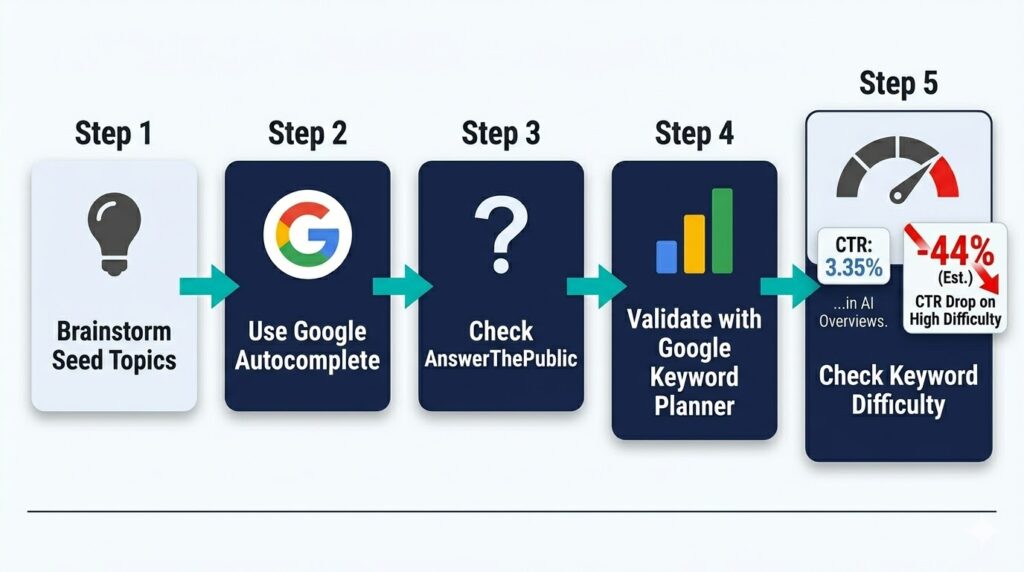
Step 1: Start With Seed Topics, Not Keywords
Most beginners make the mistake of jumping straight to a keyword tool and searching for the first term that comes to mind. Start one step back.
A seed topic is a broad subject area directly related to your business. If you run a local SEO agency, your seed topics might be: local SEO, Google Business Profile, citation building, rank in Google Maps, small business SEO. If you run a web design studio, your seeds might be: WordPress website, website speed, landing page design, mobile-friendly website.
Write down five to eight seed topics. These become the starting points for every keyword you will research. You are not looking for keyword ideas yet. You are mapping the territory your content should cover.
Step 2: Use Google Autocomplete and People Also Ask
Google itself is one of the most powerful free keyword research tools available. Open an incognito browser window so your personal search history does not skew results, and start typing one of your seed topics into the search bar without pressing enter.
Google’s autocomplete suggestions are based on what real people are actually searching for. Every suggestion is a potential keyword. Write down every variation that is relevant to your business.
After you run a search, scroll down to the People Also Ask box. These are question-based queries directly related to your search that Google has identified as commonly asked. Each one is a potential article or FAQ section. And if you click any question to expand it, new questions appear below, giving you an almost unlimited list of real search queries for free.
Also check the Related Searches section at the bottom of the results page. This shows you the LSI keywords and semantic variations that Google associates with your original query, exactly the kind of secondary keyword targets you should be weaving into your content naturally.
Step 3: Use AnswerThePublic for Question-Based Keywords
AnswerThePublic is a free tool that visualises search questions around any topic. Type in a seed keyword and it generates a wheel of questions organised by who, what, where, when, why, and how.
For an SEO agency, typing “keyword research” into AnswerThePublic produces questions like “how does keyword research work,” “why is keyword research important for SEO,” “what keyword research tools are free,” and dozens more. Every one of these is a potential article title or FAQ topic.
The free tier limits you to a small number of searches per day, which is plenty for a small business doing initial keyword planning. Use it to identify the questions your target audience is actively asking, then build content that answers those questions directly.
Step 4: Validate Search Volume in Google Keyword Planner
Google Keyword Planner is completely free and requires only a Google Ads account, which also costs nothing if you never run an ad.
Keyword Planner was built for advertisers but works well for organic keyword research. Enter the keywords you have collected so far and it shows you monthly search volume ranges, seasonal trends, and related keyword suggestions.
One technique that unlocks more precise data: create a Google Ads account, go through the setup process, but do not add a payment method or launch a campaign. Once you reach the campaign creation stage, navigate to Keyword Planner from the Tools menu. Accounts that have not run ads see volume ranges like “1K to 10K” rather than exact numbers. For most small business keyword research, this level of detail is entirely sufficient to prioritise which topics to target first.
Focus on keywords with at least 100 monthly searches. Below that, the traffic potential is usually too small to justify a full article. Look for terms with clear informational or commercial intent that match what your business offers.
Step 5: Check Keyword Difficulty With Ahrefs Free Tools
Ahrefs offers a free keyword difficulty checker that allows a limited number of searches per day. Type in any keyword and it gives you a difficulty score from 0 to 100.
For a new or low-authority website, target keywords with a difficulty score below 30. These are terms where you can realistically rank within six to twelve months with good content and some off-page work. Keywords with difficulty scores above 50 are typically dominated by high-authority sites that have been building links for years.
This is not a permanent rule. As your domain authority grows, so does your ability to compete for harder keywords. But starting with lower-difficulty terms gives you early traffic wins that build momentum, credibility, and internal link equity across your site.
As a benchmark, Ahrefs’ keyword research guide recommends that new sites focus heavily on long-tail keywords, specific three to five word phrases with lower search volume but much lower competition. These terms often have stronger buying intent and convert better than broad, high-volume keywords even when search volume is smaller.
Step 6: Organise Your Keywords Into Topic Clusters
Once you have a list of validated keywords, organise them into clusters around each seed topic. Each cluster should have one primary keyword for a pillar page and several supporting keywords for related articles that link back to it.
For example, a cluster around “local SEO” might include:
A pillar article targeting “local SEO guide for small businesses.” Supporting articles targeting “how to optimise Google Business Profile,” “local citation building,” “how to get more Google reviews,” and “local SEO for plumbers.” Each supporting article links back to the pillar page and to each other where relevant.
This is exactly the structure we use for DigitixLab’s own blog, and it is what you should be building from the beginning if you want topical authority rather than a collection of disconnected posts. For more on how keyword placement works once you have your list, our on-page SEO checklist covers exactly where and how often to use each keyword across your pages.
Key Takeaways
Free keyword research is not a compromise. For most small businesses, especially in the early months of building a site, the free tools covered in this guide provide everything you need to identify, validate, and prioritise keywords that can drive real organic traffic.
The process is simple. Brainstorm seed topics from your services. Mine Google Autocomplete and People Also Ask for real search queries. Use AnswerThePublic for question-based content ideas. Validate volume in Google Keyword Planner. Check difficulty with Ahrefs free tier. Then organise everything into topic clusters and start publishing.
The businesses that rank consistently are not the ones with the most expensive tools. They are the ones that do the research and then actually create the content. Start there, and the paid tools will make more sense, and be worth the investment, when the time comes.
Frequently Asked Questions
What is the best free keyword research tool for beginners?
For most beginners, Google Keyword Planner combined with Google Autocomplete is the most practical starting point. Both are completely free, require no subscription, and provide search volume data and keyword ideas directly from Google’s own data. AnswerThePublic and Ahrefs’ free keyword difficulty checker add useful layers once you have your initial keyword list.
What is a good keyword difficulty score for a new website?
For new websites or sites with low domain authority, target keywords with a difficulty score below 30 on Ahrefs’ 0 to 100 scale. These keywords offer realistic ranking potential within six to twelve months with good content and some off-page link building. As your domain authority grows, you can gradually target higher-difficulty terms.
What are long-tail keywords and why do they matter?
Long-tail keywords are specific phrases of three or more words with lower search volume but lower competition than broad terms. For example, “SEO for small business” is a broad keyword, while “SEO for small business in Melbourne” is a long-tail variation. Long-tail keywords are easier to rank for, often have stronger buyer intent, and tend to convert better than high-volume general terms.
How often should I do keyword research?
For a new site building out its content calendar, a full keyword research session every one to two months is sufficient. This gives you enough keywords to plan six to eight weeks of content at a time. As your site grows and you start monitoring performance in Google Search Console, you can refine your keyword targeting based on which queries are already generating impressions but not yet ranking in the top positions.
Can I do keyword research without any tools at all?
You can get surprisingly far using only Google. Google Autocomplete, People Also Ask, Related Searches, and Google Trends are all free and powered by real search data. The limitation is that you cannot see exact search volumes or keyword difficulty scores without a tool. For a very early-stage site with a limited budget, starting with just Google and adding free tools like AnswerThePublic and Ahrefs’ free checker is a perfectly viable approach.