
A few years ago, a freelance web designer in Toronto published a single guest post on a well-known design blog. The post was practical, specific, and genuinely useful. It included one natural link back to her portfolio site.
Within three weeks, her domain rating moved from 4 to 11. One of her portfolio pages started ranking on page two for a keyword she had been trying to crack for months. And she received two client enquiries from readers of that guest post who clicked through directly.
One article. One link. Real results.
That is what guest posting does when it is done right. And the reason most businesses either skip it or do it badly is that they misunderstand what it actually is.
What Is Guest Posting and Why Does It Still Work in 2026
Guest posting, also called guest blogging, is the practice of writing and publishing an article on someone else’s website in exchange for a contextual backlink to your own site. You provide value to their audience, and in return you gain exposure and a link that signals trust to search engines.
The reason it still works, despite years of people declaring it dead, is that it aligns exactly with what search engines reward in 2026. Google does not penalise guest posting. It penalises low-quality content, irrelevant links, and manipulative link schemes. A well-written, genuinely useful article on a credible, niche-relevant site is the opposite of that.
According to data cited by 3way.social’s 2026 guest posting research, businesses that run consistent guest posting campaigns see 35% faster organic growth compared to those using only on-site optimisation. And from Backlinko’s 2026 definitive guide, websites with strong editorial backlink profiles hold their rankings significantly longer after algorithm updates than those without them.
The landscape has changed in one important way. As the same research notes, AI-generated content has flooded many guest posting platforms and caused editors to become far more selective. The days of submitting a thin, generic post to any site that would take it are over. What works now is pitching specific, genuinely expert content to sites with real audiences and editorial standards.
That actually makes guest posting more valuable for businesses that do it properly, not less. The barrier to entry has risen, which means the competition for quality placements is smaller than ever.
How Guest Posting Builds SEO Authority Specifically
Understanding why it works mechanically helps you do it more strategically.
When a high-authority domain links to your website, Google treats it as a trust signal. That trust transfers a portion of the linking site’s authority to your domain, which raises your overall domain authority and makes it easier for all your pages to rank, not just the one that was linked to.
This is why a single link from a respected publication can move a domain rating more in one month than a year of on-site tweaks. The trust cascade affects the entire site.
Guest posts also create what SEO professionals call topical relevance signals. If your site is consistently mentioned and linked from other sites in your niche, Google begins to associate your domain with that subject area. That is one of the foundations of topical authority, which we covered in detail in our complete SEO guide for small businesses.
There is also the AI citation dimension. As we discussed in our guide to GEO and AI search optimisation, AI platforms like ChatGPT and Google AI Overviews evaluate brand credibility across the entire web, not just your own site. Third-party mentions and links from credible sources are exactly the kind of distributed authority signal that gets your brand cited in AI-generated answers.
How to Find the Right Sites to Pitch
This is where most guest posting attempts fail. Businesses pitch the wrong sites, get ignored, and conclude that guest posting does not work.
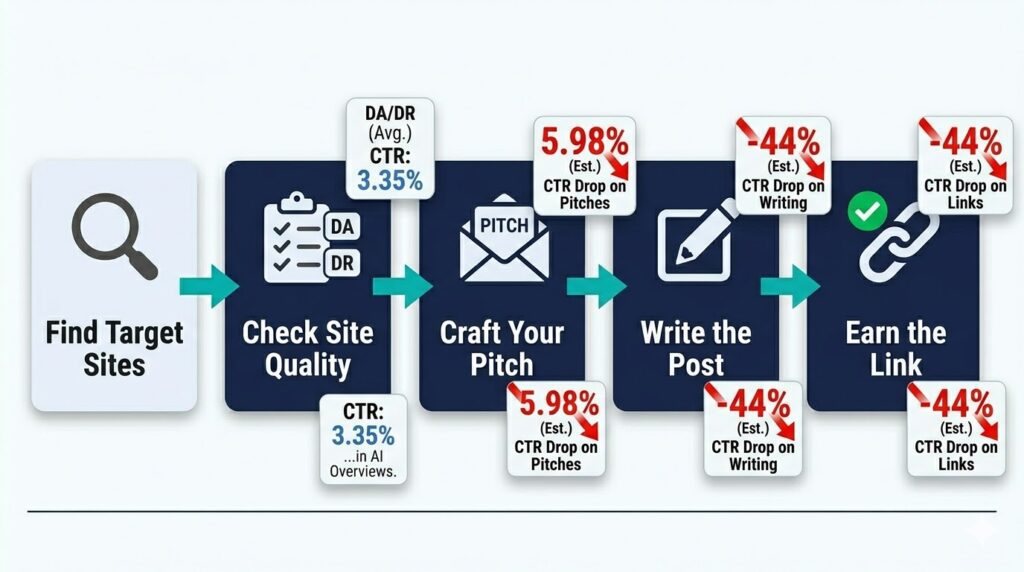
The right site has three qualities: it is relevant to your niche, it has a real audience, and it has genuine editorial standards.
Domain authority score matters, but it is not the whole picture. A site with a Domain Authority of 35 that publishes consistently, has real traffic, and writes seriously about your industry is a better target than a DA 60 site that accepts anything and publishes twenty posts a day with no editorial filter.
To find targets, start with what you already read. What blogs, publications, or industry sites do you follow in your niche? Those are your first-tier targets because you already understand their content and audience. Then search Google for “[your niche] + write for us” or “[your topic] + guest post guidelines.” Most sites that accept guest contributions publish submission guidelines.
Before you pitch, check the site’s content quality manually. Read three or four recent articles. Does the writing reflect genuine expertise? Are there comments, shares, or engagement signals that suggest a real readership? Is the content well-structured and specific rather than generic? If yes, the site is worth your time.
Also check the backlink profile of the site using Ahrefs’ free tool or Semrush. If a site has thousands of outbound links with no clear editorial consistency, it is likely part of a link network. Links from those sites carry little value and can occasionally harm your profile if they appear manipulative.
How to Write a Pitch That Actually Gets Accepted
Editors at quality sites receive dozens of pitches every week. Most are ignored not because the sender is unqualified, but because the pitch is generic.
A strong pitch does four things in under 200 words. It shows you have read the site and understand the audience. It proposes a specific, useful topic that the site has not already covered. It establishes your credibility briefly and concretely. And it makes it easy for the editor to say yes with a clear, simple ask.
Do not open with “I found your site and loved it.” Editors have read that sentence ten thousand times. Open with the topic idea instead. “I would like to contribute an article on [specific topic] for [site name]. Here is a brief outline of what I would cover and why it would be useful for your readers.” That directness stands out immediately.
Keep the subject line specific. “Guest post idea: [proposed title]” performs better than “Guest post enquiry” because it tells the editor immediately what you are proposing rather than making them guess.
What Makes a Guest Post Worth Publishing
Once your pitch is accepted, the quality of the piece determines the quality of the link. A well-written, thorough article on a high-authority site earns a dofollow contextual backlink that carries real weight. A thin or promotional piece gets rejected, or published without a link, or removed later.
Write the guest post at least as well as you would write for your own site. In practice, write it better. The piece represents your brand to an unfamiliar audience, and it signals to the editor whether future pitches are worth reading.
The link to your site should appear naturally within the content where it adds genuine value for the reader. A link that appears because it is contextually useful is far more effective than one crammed into an author bio.
On anchor text, use descriptive phrases rather than exact-match keywords. “DigitixLab’s off-page SEO guide” is natural. “best SEO services” repeated across multiple guest posts looks manipulative. Vary your anchor text across different guest posts the same way a natural editorial mention would.
How Often Should You Guest Post
For a new or growing website, one to two quality guest posts per month is a realistic and sustainable target. That cadence builds a natural-looking link velocity, which is what Google’s link quality signals evaluate alongside raw backlink counts.
According to data from BacklinksHatch cited in MEXC News’ 2026 analysis, clients running consistent monthly guest posting campaigns see an average domain authority increase of 8 to 12 points within six months. That kind of movement accelerates ranking timelines across the entire site, not just the pages being directly linked to.
The compound effect is the real reason to take guest posting seriously long-term. Each guest post you publish remains on the web indefinitely. The links continue contributing to your authority months and years after publication. The referral traffic continues coming in. And your brand continues appearing in search results on the host site for every reader who finds that article organically.
If you want to offer guest posting as a service to your own clients, the link building and outreach services at DigitixLab are built around exactly this strategy, connecting client brands with relevant, high-quality guest posting opportunities that build lasting authority.
Wrapping It Up
Guest posting is not a shortcut and it is not outdated. It is a compounding authority-building strategy that rewards consistency, quality, and relevance above all else.
Start with one well-researched pitch per month to a site you genuinely respect in your niche. Write the piece properly. Place the link naturally. Then repeat. After six months, the cumulative effect on your domain authority, your rankings, and your AI search visibility will be visible and measurable.
It is one of the few off-page tactics where the output, a real article on a real site, keeps working for you indefinitely after you have done the work.
Frequently Asked Questions
What is guest posting in SEO?
Guest posting in SEO is the practice of writing and publishing an article on another website in exchange for a contextual backlink to your own site. It builds domain authority, establishes topical relevance, and drives referral traffic from an established audience. It is one of the most widely used and durable white-hat link building strategies available.
Does guest posting still work in 2026?
Yes. According to 3way.social’s 2026 guest posting research, businesses that run consistent guest posting campaigns see 35% faster organic growth than those relying only on on-site optimisation. What has changed is the quality bar. AI-generated content has made editors more selective, which means high-quality, expert-written guest posts are now more valuable and less common than they used to be.
How do I find websites that accept guest posts?
Search Google for “[your niche] + write for us” or “[your topic] + guest post guidelines.” Most sites that accept contributions publish their criteria publicly. You can also identify sites you already read in your industry and check whether they feature external contributors. Prioritise sites with real audiences, genuine editorial standards, and content relevant to your niche.
How many guest posts should I publish per month?
For a new or growing website, one to two quality guest posts per month is a sustainable and effective cadence. This builds a natural-looking link velocity that Google evaluates positively. Prioritise quality over volume. One well-placed post on a high-authority relevant site is worth more than ten posts on low-traffic unrelated blogs.
Is paid guest posting safe for SEO?
Paid guest posting is common but carries risk if done carelessly. Google’s guidelines require that paid links carry a “sponsored” or “nofollow” attribute. Many paid guest posting services place dofollow links without disclosure, which technically violates Google’s link scheme policies. If you use paid placements, prioritise sites with real traffic, genuine editorial standards, and transparent disclosure practices rather than link farms or private blog networks.