
Quick Answer: Google AI Overviews are AI-generated answer panels that appear at the top of Google search results, summarising answers to user queries before they ever see an organic link. According to Ahrefs’ February 2026 data, AI Overviews now reduce organic clicks by 58%, and organic CTR has dropped up to 61% on queries where AI Overviews appear. To stay visible, businesses need to shift from optimizing purely for rankings to optimizing for AI citations, brand authority, and content structure that both Google and AI search engines can extract and reference.
A digital marketing manager checked her Google Search Console in January and nearly fell out of her chair.
Impressions were up 27%. Rankings had barely moved. But clicks were down 36%. Revenue from organic search was slipping for the third month in a row.
Nothing had changed on the site. No algorithm penalty. No technical issue. The culprit was something most of her competitors had not even heard of yet.
Google AI Overviews had quietly expanded across the keyword categories her site depended on, and users were getting their answers without ever clicking through.
This is not a niche problem. It is one of the most significant shifts in search behaviour in the last decade, and every small business with an SEO strategy needs to understand it.
What Are Google AI Overviews and How Do They Work
Google AI Overviews, previously called Search Generative Experience or SGE, are AI-generated summary panels that appear at the very top of Google search results. They use Google’s Gemini AI model to pull information from multiple sources across the web and present a consolidated answer directly on the results page.
When a user asks an informational question, Google may generate an AI Overview that answers it fully, right there on the page, before the user ever sees a single organic link. Those traditional blue links are still there, but they are now pushed further down the page, often well below the fold.
Google rolled out AI Overviews to all US users in May 2024 and has since expanded them globally. By early 2026, AI Overviews were appearing on an estimated 20 to 25% of all search queries, with that figure continuing to rise.
The Real Numbers: How Bad Is the CTR Drop
The data from multiple independent studies makes the scale of this shift very clear.
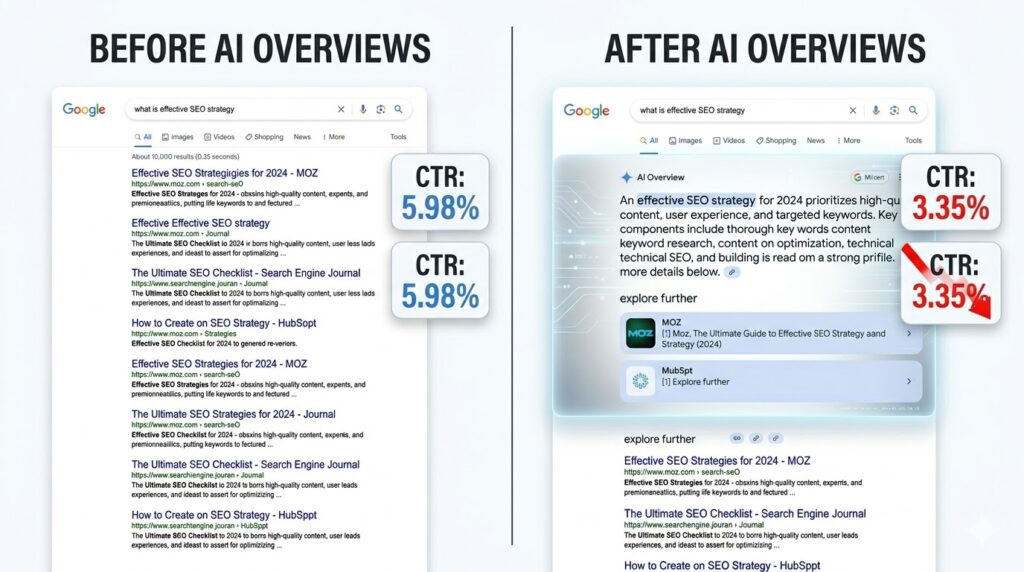
According to Ahrefs’ analysis of 300,000 keywords published in February 2026, position one organic CTR dropped by 34.5% when an AI Overview was present. For the broadest informational queries, organic CTR fell from 5.98% to 3.35%, a 44% drop, even when rankings stayed exactly the same.
Search Engine Land’s reporting on the Amsive study, which analysed 700,000 keywords across five industries, found an average CTR drop of 15.49%, with specific cases showing losses as high as 37%. And when AI Overviews combined with featured snippets on the same query, the drop hit 37% in some verticals.
For publishers producing high-volume informational content, some sites have reported up to 89% traffic declines on certain query types.
The pattern is consistent across all the data: impressions go up because AI Overviews create additional impression triggers, but clicks go down because users are getting answers without leaving Google.
Who Is Most Affected
Not all websites are equally exposed to AI Overview impact. Here is how the risk breaks down:
| Content Type | AI Overview Risk | Why |
|---|---|---|
| Informational how-to articles | Very High | AI can fully answer these without a click |
| Definition and explainer pages | Very High | Simple answers AI summarises easily |
| Local service pages | Low to Medium | Users need contact info and specifics |
| Product pages and pricing | Low | Transactional intent still drives clicks |
| Case studies and original data | Low | AI cannot replicate unique data |
| Opinion and experience content | Low | Personal voice cannot be summarised by AI |
If your site relies heavily on top-of-funnel informational content like “what is X” or “how does Y work,” you are in the highest-risk category. Service pages, pricing pages, and content with original data are far more protected.
The Counterintuitive Upside: Being Cited in AI Overviews
Here is the part most people miss when they see the traffic decline data.
While AI Overviews reduce clicks for most organic results, brands that get cited inside the AI Overview see the opposite effect. According to Amsive’s research cited by Search Engine Journal, branded queries with AI Overview citations see an 18% increase in click-through rate compared to the same queries without that citation.
When Google’s AI Overview mentions your brand by name and references your content, it functions as an endorsement. Users see that before they see anything else. That visibility builds brand authority in ways that a position four ranking never could.
And according to Ahrefs data, 76.1% of URLs cited in AI Overviews also rank in the top ten organic positions. Strong traditional SEO is still the foundation for AI citation. You cannot skip the fundamentals and expect the AI to find you.
What to Do Right Now: The Practical Adaptation Strategy
This is not a situation that calls for panic or abandoning SEO. It calls for a specific set of adjustments.
Shift Your Content Mix Toward Mid and Bottom Funnel Topics
Top-of-funnel informational content like “what is SEO” or “how does on-page SEO work” is the most displaced category. AI can summarise those answers easily.
Mid-funnel content like “on-page SEO checklist for small businesses” and bottom-funnel content like “best SEO agency for small business in the USA” are far less likely to be answered fully by an AI Overview because they require specifics, comparisons, and contextual judgment.
Shift your content calendar toward topics that require real expertise, local knowledge, original data, or comparative analysis. Our on-page SEO checklist for small businesses is a good example of the type of content that holds up in an AI Overview world.
Structure Content for AI Extraction and Citation
Even for informational content, your goal should shift from ranking to being cited inside the AI Overview. The content that gets cited shares specific characteristics.
It opens with a direct answer in the first paragraph. It uses clear H2 and H3 headings. It includes specific, verifiable statistics with named sources. And it keeps paragraphs short so AI systems can extract specific passages cleanly.
This is exactly the writing approach we built into our complete SEO guide for small businesses and our GEO optimisation guide. The same structure that earns AI citations also improves traditional rankings.
Build Brand Authority Through Original Content and Third-Party Mentions
AI Overviews favour content from brands that have established credibility across the web, not just on their own site. Guest posting, digital PR, podcast appearances, and citations in third-party articles all build the kind of distributed brand authority that AI systems recognise.
Publishing original data is especially powerful. Case studies, survey results, and unique analysis are content types that AI cannot generate from scratch. They become citable sources by definition.
Track AI Overview Visibility Separately
Google Search Console now includes impression data that captures both traditional organic and AI Overview triggers. The challenge is you cannot currently filter them apart cleanly.
The most practical approach is to monitor keyword-level click and impression data for your most important queries. If impressions are rising but CTR is falling, you are likely experiencing AI Overview displacement. That is the signal to start optimising those specific pages for citation rather than just ranking.
Summary and Action Plan
Google AI Overviews are not going away. The data from every independent study points in one direction: AI-generated answers are expanding, clicks are declining for pure informational queries, and brands that get cited inside those AI answers are the ones seeing resilience.
The right response is not to abandon SEO. It is to build on it. Strong rankings are still the foundation for AI citation. Original, well-structured, expert content earns both. And brand authority, built through consistent publishing, guest posts, and third-party mentions, compounds over time in ways that no algorithm change can fully erase.
Start by auditing your top-performing pages. Identify which ones are informational and most exposed to AI Overview displacement. Update their structure to lead with direct answers, add specific cited data, and rebuild them around earning a citation rather than just a ranking position.
The businesses that adapt to this shift now will be the ones with durable visibility in 2026 and beyond.
Frequently Asked Questions
What are Google AI Overviews?
Google AI Overviews are AI-generated summary panels that appear at the top of Google search results. They use Google’s Gemini model to pull information from multiple web sources and answer a user’s query directly on the results page, often before the user clicks any organic link.
How much do Google AI Overviews reduce organic traffic?
According to Ahrefs’ February 2026 analysis of 300,000 keywords, position one organic CTR drops by 34.5% when an AI Overview is present. Other studies from Amsive and Seer Interactive show average CTR declines between 15% and 61% depending on the query type, with informational content being the most affected.
Can my website appear inside a Google AI Overview?
Yes. According to Ahrefs data, 76.1% of URLs cited in AI Overviews also rank in the top ten organic positions. To increase your chances of being cited, use answer-first writing, include specific verifiable statistics, structure content with clear headings, and build domain authority through quality backlinks and third-party mentions.
Which types of content are least affected by AI Overviews?
Service pages, pricing pages, case studies, original data, and content with a strong personal or expert voice are least affected. AI Overviews most commonly displace pure informational content like definitions, how-to guides, and explainer articles where the answer can be fully summarised without a click.
Should I stop creating informational content because of AI Overviews?
No. Informational content still drives awareness, topical authority, and AI citations. The shift is in how you write it. Lead with direct answers, use cited data, structure it clearly, and aim to be the source the AI Overview references rather than a result that gets buried beneath one.