
The Short Answer: SEO typically takes three to six months to show early movement and six to twelve months to deliver meaningful traffic and leads for most small businesses. According to Shopify’s SEO research, most sites start seeing measurable results within that three to six month window. But the real answer is more nuanced than a single number, and understanding what drives the timeline is what lets you set realistic expectations and make faster progress.
A business owner reaches out to an SEO agency in January. By March, they are anxious. By April, they are frustrated. By May, they have cancelled the contract and decided SEO does not work.
Six months later, the articles published in that first campaign start ranking. The traffic arrives. But there is nobody there to see it because they gave up three weeks before the results began.
This pattern plays out constantly, and it almost always comes from the same root cause: unrealistic expectations about how long SEO takes.
This guide gives you the honest, data-backed picture of what to expect and when, so you can make smarter decisions about your time and budget.
Why SEO Takes Longer Than You Expect
Search engines do not hand out visibility rewards quickly. That is by design, not a flaw.
Google’s entire value proposition is trust. When a user types a query, Google needs to be confident it is surfacing a genuinely useful, reliable result. If rankings moved within days of publishing a new page, every spammer and low-quality site would immediately game the system.
Instead, Google evaluates your content over time. It crawls your pages, indexes them, assesses how users interact with them, monitors whether other credible sites reference you, and gradually adjusts your rankings based on accumulated evidence.
According to former Google Search Advocate John Mueller, indexing a new page typically takes anywhere from a few days to a few weeks. Ranking for competitive keywords, where the evidence-gathering process is more thorough, takes considerably longer.
This is also why domain age matters. A site that has been publishing quality content and earning links for two years has already built a track record. A new site has to establish that trust from scratch, which is the main reason new domains tend to see slower initial results regardless of content quality.
The Month-by-Month SEO Timeline
Based on research compiled from Shopify’s SEO timeline study, WolfPack’s 2026 SEO timeline guide, and SEO.com’s realistic timeline breakdown, here is what most small businesses can expect at each stage.
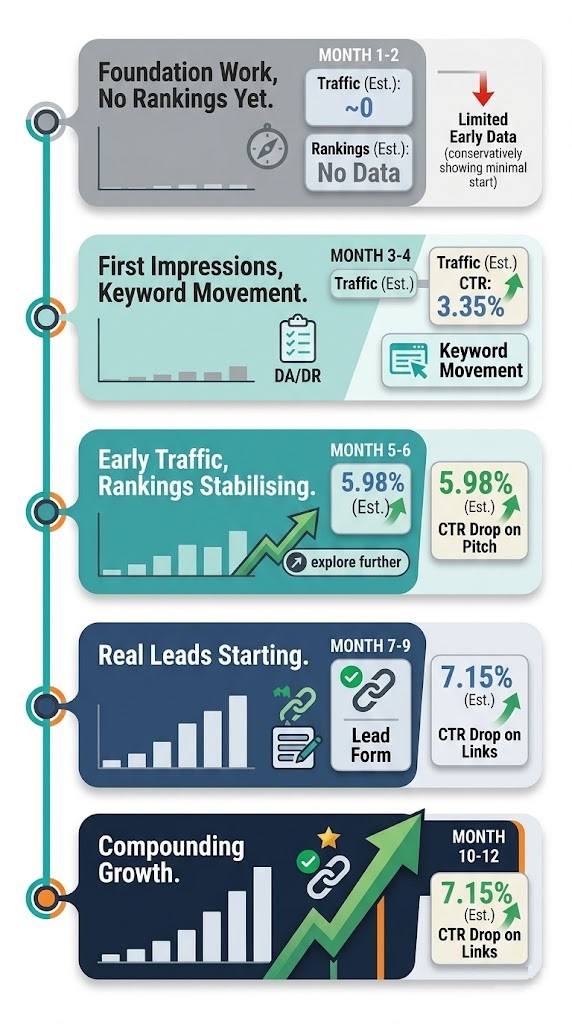
Months 1 to 2: Foundation Work This phase is almost entirely invisible from the outside. You are fixing technical issues, setting up analytics, completing keyword research, and publishing the first wave of optimised content. Google is beginning to crawl your pages, but rankings have not moved because there is not enough evidence yet to evaluate. Do not expect any significant traffic increase during this window.
Months 3 to 4: First Signs of Life Around the three-month mark, most sites start to see early movement. Impressions in Google Search Console begin climbing. A handful of keywords move onto pages two or three. You may see small upticks in organic traffic. These are not results yet. They are signals that Google is beginning to take your content seriously.
Months 5 to 6: Rankings Begin Stabilising This is when things start to feel real. Several target keywords move onto page one, typically lower positions initially. Organic traffic climbs noticeably. Enquiries from organic search may start appearing. This is the phase where businesses that maintained consistency through months one to four begin seeing the payoff.
Months 7 to 9: Momentum Builds Rankings consolidate, often moving from position eight to position three on key terms. Blog posts begin ranking for secondary keyword variations beyond their primary target. Backlinks earned in earlier months start contributing more meaningfully to domain authority.
Months 10 to 12: Compounding Growth This is the stage most people never reach because they quit too early. Content published in month one is now well-indexed, has accumulated engagement signals, and may have earned natural backlinks from readers. The traffic-to-effort ratio begins improving dramatically. According to SEO.com’s analysis, significant revenue gains from organic search typically materialise between months six and twelve, with the cost-per-lead from SEO continuing to fall as traffic compounds without proportional increases in effort.
Five Factors That Change Your Timeline
Two businesses can start SEO at the same time, in the same industry, and see dramatically different timelines. These are the five variables that explain most of that difference.
1. Domain Age and Existing Authority
A website that has been active for three years, even with minimal optimisation, has more baseline trust than a brand new domain. It has an index history, possibly some natural backlinks, and a pattern of activity that Google can evaluate. New domains need to build that trust from scratch, which typically adds two to three months to the timeline before meaningful rankings appear.
2. Keyword Competition
Targeting “SEO agency” as a new website is a multi-year project. Targeting “SEO agency for dentists in Brisbane” as a new website is achievable within six months. The more specific and less competitive your initial targets, the faster you will see results. This is why our keyword research guide emphasises starting with low-difficulty, long-tail terms before moving toward broader, more competitive keywords.
3. Content Consistency
Google rewards sites that publish regularly. A site publishing two quality posts per week builds topical authority and crawl frequency faster than a site publishing one post per month. Publishing and stopping, which is exactly what many new sites do, resets the momentum. Consistency is the single most controllable factor in your timeline.
4. Technical Health
A site with slow load times, crawl errors, duplicate content, and missing meta tags forces Google to work harder to understand it. Every technical issue is a friction point that delays ranking. Our on-page SEO checklist covers the specific items to audit first, and our technical SEO checklist covers the backend issues that slow everything down.
5. Off-Page Authority Building
Content alone is not enough for competitive keywords. Backlinks from other credible sites are what tell Google your content is worth trusting. Sites that actively build off-page authority through guest posting, digital PR, and citation building see notably faster timelines than those relying on content alone. We covered the full strategy in our off-page SEO guide and our guest posting guide if you want to go deeper on both.
What to Do When Results Feel Slow
Slow results are almost always explained by one of three things: the keywords are too competitive for the current domain authority, the content is not publishing consistently enough, or a technical issue is limiting crawl efficiency.
Before assuming SEO is not working, check Google Search Console. If impressions are growing even without clicks, Google is finding and assessing your content. That is a healthy early signal. If impressions are flat, there is likely a crawl or indexing issue worth investigating.
Also check your keyword targets. If you started with high-difficulty terms and have a new domain, switching to lower-competition variations of the same topics will show results faster while your domain authority catches up.
The one thing that genuinely does not work is stopping and restarting. Every time a site goes quiet, Google deprioritises its crawl frequency, and the momentum built during active periods partially resets.
What You Should Do Next
Set a twelve-month commitment before you evaluate SEO as a channel. Not because results take that long to appear, they typically do not, but because twelve months gives you enough of a compounding return to accurately judge the ROI.
In months one to three, focus on technical health and keyword research. Months four to six, focus on consistent publishing and internal link building. Months seven to twelve, focus on off-page authority and expanding your keyword coverage.
If you want a professional assessment of where your site currently stands and a realistic projection for your specific niche, the free SEO audit at DigitixLab identifies the specific bottlenecks holding your rankings back and outlines a clear path forward.
SEO is a long game. The businesses that understand that and stay consistent are the ones that build compounding organic traffic that no ad spend can replicate.
Frequently Asked Questions
How long does SEO take for a brand new website?
New websites typically need four to six months before consistent SEO results appear. The first two months focus on technical foundation and initial content. Early ranking signals typically appear around months three to four. Meaningful traffic and leads from organic search usually arrive between months six and twelve for most small business niches.
Can SEO work faster than three months?
In some cases, yes. Highly specific long-tail keywords in low-competition niches can rank within four to eight weeks of publishing well-optimised content. Local SEO improvements, such as Google Business Profile optimisation and local citation building, often show results faster than organic content rankings. Technical SEO fixes can also produce quick wins by resolving crawl or indexing issues that were actively suppressing rankings.
Does SEO take longer for competitive industries?
Yes, significantly. In highly competitive industries like digital marketing, legal services, or financial products, building enough domain authority to rank for primary keywords can take twelve to twenty-four months or longer for new sites. The strategy in these cases is to build authority gradually through long-tail content and consistent link building before targeting the most competitive terms.
Why are my impressions going up but not my clicks?
This is a normal early SEO signal. Rising impressions mean Google is finding and indexing your content and beginning to surface it for relevant queries. Clicks will follow as rankings move from lower positions, where clicks are rare, toward the top three positions, where most clicks are earned. This transition typically happens between months four and eight for most sites.
How do I know if my SEO is working?
Track four metrics in Google Search Console: total impressions, average position, click-through rate, and total organic clicks. Impressions rising first is healthy. Average position improving follows. Clicks increasing after that is the final confirmation. If all four are flat after six months of consistent effort, there is likely a technical, content quality, or keyword targeting issue worth reviewing.